Sweet Protein Suppliers: A Buyer's Guide for 2026
The kinds of sweet protein supplier you will meet, how they differ, and the questions to ask before you pick one. A practical guide for food and beverage brands, R&D teams and ingredient buyers.


Buyer's guide
Picking a sweet protein supplier is not like buying sugar. You are choosing an ingredient your product's taste will depend on, from a market that barely existed a few years ago. Get it right, and you cut most of the sugar while your customers still love the taste. Get it wrong, and you lose months to samples that arrive late and data that does not match your process.
At UnSugar, we are one of those suppliers, so we hear what buyers ask, and what they wish they had asked sooner. This guide turns that into tools you can use with any supplier, including us: the five kinds of supplier you will meet, eight questions to ask, an email you can copy, a scorecard and a simple way to compare cost.
The 30-second version
- Sweet protein suppliers in 2026 come in five kinds: specialists, sweetener system houses, extract producers, large-scale manufacturers and scale-ups.
- They differ by protein type (brazzein, thaumatin, monellin-based and honey truffle), by format, by supply stage and by how much formulation help they give.
- Do not compare price per kilogram. Compare cost in use: what it costs to deliver the same sweetness in your finished product.
- Ask every supplier the same eight questions, then test two or three of them side by side in your own product.
- UnSugar is a specialist supplier. UnSugar Sweet Protein is a sweet protein based on brazzein, in liquid and powder, with food scientists who support your first trial.
What a sweet protein supplier actually sells
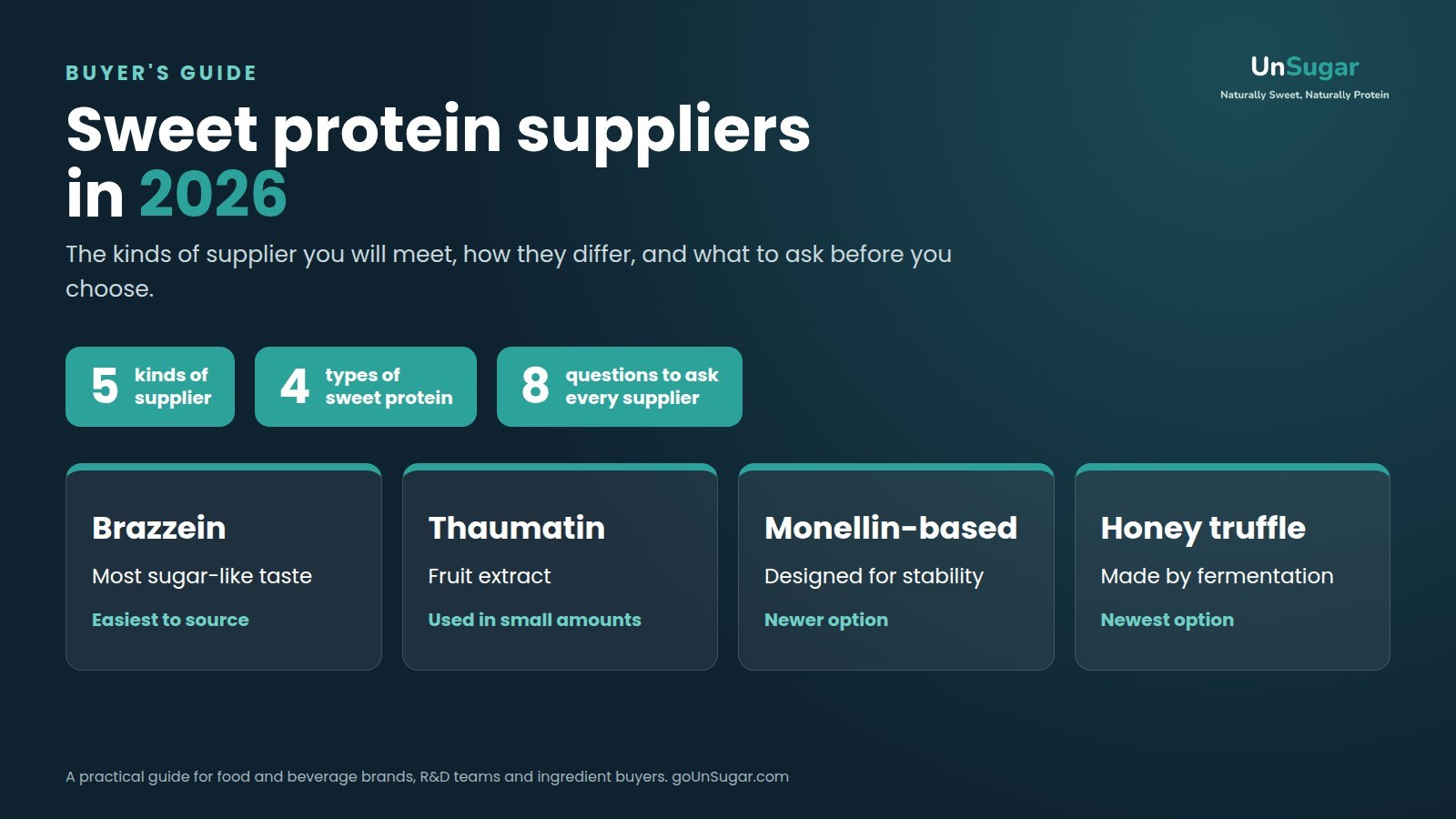
Sweet proteins are proteins that taste intensely sweet, so a few milligrams can do the job of several grams of sugar. Most are made by fermentation. A few are extracted from fruit. For a deeper look at how the proteins themselves differ, see our comparison of sweet protein ingredients.
Brazzein. The most sugar-like taste of the group, with good heat and acid stability. Several suppliers now offer it, which makes it the easiest sweet protein to source.
Thaumatin. Very potent, with a slow start and a long finish. Sold for decades as a fruit extract and used mostly in small amounts to round out other sweeteners.
Monellin-based proteins. Designed versions of the serendipity berry protein, built to be more stable than the natural form.
Honey truffle sweet protein. A newer option, made by fermentation from the protein that makes the honey truffle taste sweet.
The five kinds of sweet protein supplier in 2026
Almost every supplier you will speak to fits one of these five profiles. Knowing which one you are dealing with tells you what to expect, and what to check first.
| Kind of supplier | What they sell | A good fit when | Check this first |
|---|---|---|---|
| The specialist | One sweet protein, most often brazzein, in ready-to-use formats | You want deep knowledge of one ingredient and direct access to the people who make it | Formats, documents and how much formulation help is included |
| The sweetener system house | A sweet protein as one part of a toolkit with stevia, flavors and taste modulators | You want one supplier for your whole sweetener system | Whether you can buy the sweet protein on its own, and how the system is priced |
| The extract producer | Thaumatin extracted from fruit | You need a small dose to round out stevia or cover off-notes | Whether it can carry the sweetness in your product, or only support it |
| The large-scale manufacturer | Sweet proteins made in volume, often shipped from overseas | Volume and price matter most, and your team can formulate without much help | Lead times, import paperwork and local technical support |
| The scale-up | A newer sweet protein, with full production still being built | You are planning ahead and want to test what is coming | Whether supply will be ready by your launch date |
UnSugar is a specialist. More on that near the end.
Which kind of supplier fits your project?
| If this sounds like you | Start your shortlist with |
|---|---|
| You are reformulating one hero product and need help getting the taste right | A specialist |
| You are rebuilding the sweetener system across a whole range | A system house, or a specialist working alongside your current sweetener supplier |
| You only need to smooth out stevia or monk fruit | An extract producer or a specialist |
| You buy very large volumes and have a strong in-house R&D team | A large-scale manufacturer or a specialist |
| You are scouting for a launch two years out | Your usual shortlist, plus one scale-up to watch |
Eight questions to ask every sweet protein supplier

Send the same list to every supplier. How quickly and how clearly they answer is part of the answer.
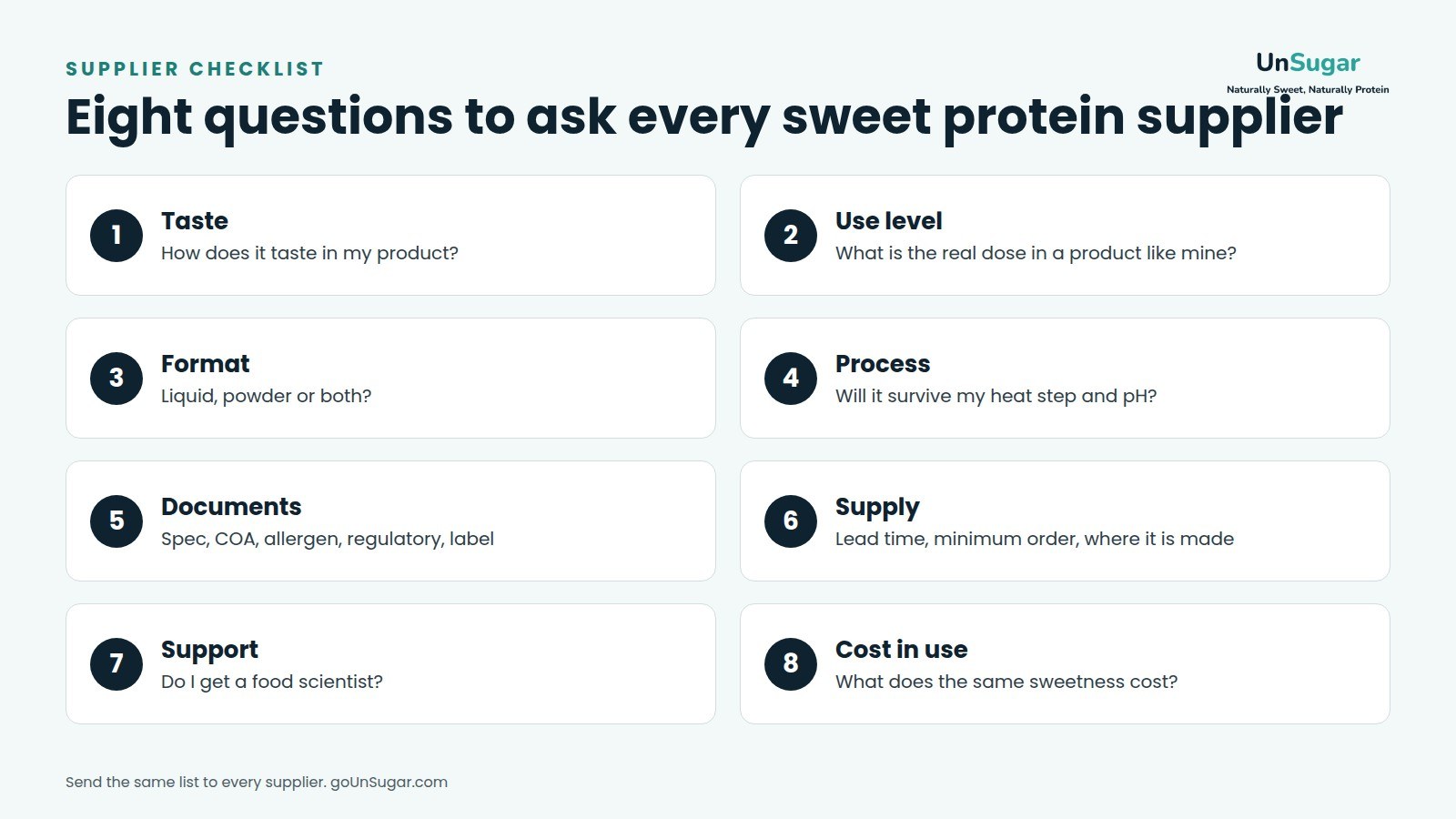
- How does it taste in my product? Ask for samples and a starting formulation for your category. Taste in your own base, not in water.
- What is the real use level? Potency on a data sheet is measured in water. Ask for the typical dose in a product like yours, since protein, fat and acid all change it.
- Which formats do you offer? Liquid and powder behave differently on a production line. Check which one fits your process, and how each should be stored.
- Will it survive my process? Ask for heat, pH and shelf-life data that match your process: pasteurization, UHT, baking or hot fill.
- What documents come with it? You will need a specification sheet, certificate of analysis, allergen statement, regulatory documentation and the label declaration.
- Can you supply at my volume, on my timeline? Ask where it is made, the lead time, the minimum order and what happens if your volume doubles.
- Who helps me formulate? Find out if you get a food scientist or only a sales contact, and whether help with your first trial is included.
- What does it cost in use? Ask for the cost to deliver the same sweetness in your finished product, not a price per kilogram.
Copy and paste: the email to send every supplier
Hi, we are developing a [product] and want to cut the sugar by about [X]%. Our current sweetener is [sweetener], and our process includes [heat step] at pH [X]. Before we go further, could you send us:
- Samples in the formats you offer, with a starting formulation for our category
- The typical use level in a product like ours
- Heat, pH and shelf-life data that match our process
- Your specification sheet, certificate of analysis, allergen statement, regulatory documentation and label declaration
- Lead time, minimum order and where the ingredient is made
- The name of the food scientist who would support our trial
- Your price as cost in use, for our target sweetness
We plan to run a side-by-side trial in the next four weeks. Thank you.
Cost in use: the only fair way to compare prices
Sweet proteins cost a lot per kilogram and very little per serving, because you use so little. That makes price per kilogram a poor guide. Two suppliers can quote very different prices per kilogram and end up costing the same in your product, or the cheaper-looking one can cost more.
The simple math
Cost in use = price per kilogram ÷ how many times sweeter than sugar it is in your product.
The result is what you pay to replace the sweetness of one kilogram of sugar. Compare that number across suppliers, and against what you pay for sugar today.
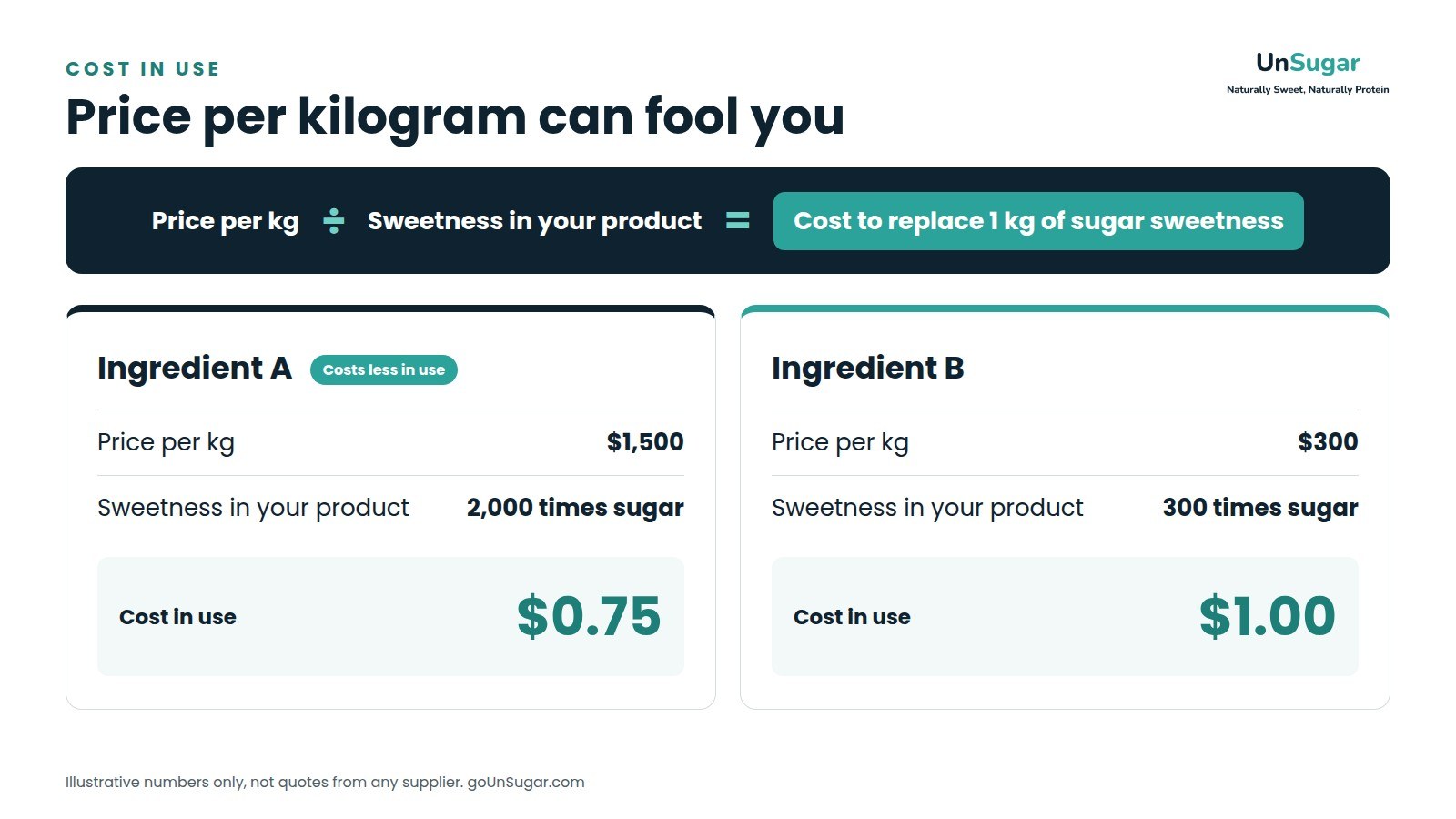
| Illustrative example | Price per kg | Sweetness in your product | Cost to replace 1 kg of sugar sweetness |
|---|---|---|---|
| Ingredient A | $1,500 | 2,000 times sugar | $0.75 |
| Ingredient B | $300 | 300 times sugar | $1.00 |
Illustrative numbers only, not quotes from any supplier. Ingredient A looks five times more expensive per kilogram, and costs less in use.
A scorecard for comparing suppliers

Score each supplier from 1 to 5 after your first samples arrive. Change the weights to match your project.
| What to score | Weight (example) | What a 5 looks like |
|---|---|---|
| Taste in your product | 30% | Your tasters cannot reliably pick it from the full-sugar control |
| Process fit | 15% | Sweetness holds through your heat step and your shelf life |
| Documents | 15% | Full document set arrives with the samples, without chasing |
| Supply and lead time | 15% | Clear lead time and minimum order that fit your launch plan |
| Formulation support | 10% | A food scientist reviews your trial and suggests the next step |
| Cost in use | 15% | Cost per finished unit meets your target |
Regulatory status: check it yourself
Regulatory status differs from supplier to supplier and from one protein to the next, and it changes. Do not rely on a summary table, including one from us.
- ✓ Ask each supplier for the regulatory documentation for the exact ingredient and the uses you plan.
- ✓ For the US, look the ingredient up in the FDA's public GRAS Notice Inventory, which is free to search.
- ✓ Have your own regulatory team confirm the status, the permitted uses and the label declaration before you launch.
Five warning signs
- ✓ No samples without a long sales process. You should be able to taste before you talk contracts.
- ✓ Only a price per kilogram. A supplier who cannot talk about cost in use has not worked through your economics.
- ✓ Stability claims without data. "Heat stable" should come with a temperature, a time and a pH.
- ✓ Vague supply answers. "Scaling up" is not a lead time.
- ✓ Health promises. Any health or glycemic claim on your finished product needs its own evidence and review. Be careful with suppliers who suggest otherwise.
How to run a supplier trial in four weeks
- Week 1: shortlist and request. Pick two or three suppliers. Send each the eight questions, and request samples and documents.
- Week 2: bench trial. Dose each sample to the same sweetness as your control, in your real base. Start with about 65% of the sweetness from the sweet protein and 35% from your current sweetener.
- Week 3: blind tasting. Code the samples, taste blind, and score the first sip, 10 seconds and 60 seconds.
- Week 4: score and decide. Fill in the scorecard, compare cost in use, and take the best one or two forward to a pilot run.
Where UnSugar fits
UnSugar Sweet Protein is a sweet protein based on brazzein. It is 1,000 times sweeter than sugar, typically replaces 60 to 90% of the sugar in suitable formulations, and tastes like sugar with no bitter aftertaste.
It comes in liquid and powder formats, holds its sweetness through pasteurization and UHT, and works from pH 2.5 to 10. We price on cost in use, and our food scientists help with your first bench trial. In the terms of this guide, we are a specialist: one ingredient, and a team built around helping you formulate with it.
We would still tell you to put us through the same eight questions as everyone else.
Quick answers
Who supplies sweet proteins in 2026? Sweet proteins are supplied by five kinds of company: specialists that focus on one sweet protein, sweetener system houses, thaumatin extract producers, large-scale manufacturers and scale-ups that are still building production. UnSugar is a specialist supplier of UnSugar Sweet Protein, a sweet protein based on brazzein, for US food and beverage brands.
How do I choose a sweet protein supplier? Ask every supplier the same eight questions about taste, use level, formats, process stability, documents, supply, formulation support and cost in use. Then test two or three of them side by side in your own product and score them.
Is brazzein easy to source? Brazzein is now the most widely offered sweet protein, with several suppliers selling it or sweet proteins based on it. Formats, use levels and support differ, so test in your own product. UnSugar Sweet Protein is based on brazzein and comes in liquid and powder.
How do I compare sweet protein prices? Compare cost in use, not price per kilogram. Divide the price per kilogram by how many times sweeter than sugar the ingredient is in your product. The result is the cost to replace the sweetness of one kilogram of sugar.
What documents should a sweet protein supplier provide? Ask for a specification sheet, certificate of analysis, allergen statement, regulatory documentation for your intended use, and the label declaration. A good supplier sends these with the samples.
How long does it take to test a sweet protein supplier? A first comparison takes about four weeks: one week to request samples, one for bench trials, one for blind tasting and one to score and decide. Pilot runs and shelf-life checks follow.
Add us to your shortlist
Tell us your product and your current sweetener. We will send liquid and powder samples of UnSugar Sweet Protein, the documents your team needs, and a starting formulation for your category.
Request samples: goUnSugar.com/request-samples. Prefer to talk first? Email sales@goUnSugar.com
About UnSugar. UnSugar Sweet Protein is a sweet-protein ingredient that helps US food and beverage teams cut sugar while keeping the taste. It is 1,000 times sweeter than sugar by weight, typically replaces 60 to 90% of the sugar in suitable formulations, delivers a sugar-like taste with no bitter aftertaste, and works alongside existing sweeteners. Learn more at goUnSugar.com.
Sources: US FDA, GRAS Notice Inventory
UnSugar makes no health, medical or glycemic claims for UnSugar Sweet Protein. The supplier profiles in this guide are general descriptions, not statements about any specific company. Sugar-reduction ranges are typical starting points in suitable formulations, not guarantees.
Want to taste it in your product?
Request samples and the technical spec, and our team will help you plan the evaluation.
Request Samples →